
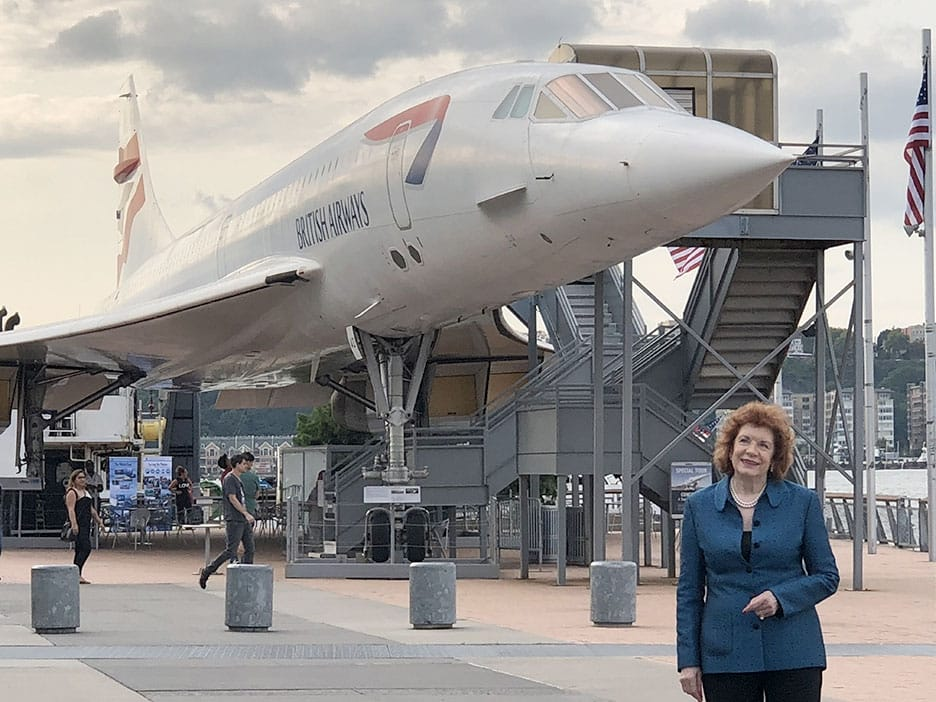
Jennifer visits Concorde G-BOAD (Alpha Delta) at the INTREPID Sea, Air & Space Museum, New York City
SUPERSONIC TIME FLIES
The Concorde Legacy
Written by Jennifer Coutts Clay, FCILT, New York, www.jetlinercabins.com
Copyright, August 2026
Jennifer is the author of JETLINER CABINS E-Book (4th edition), www.jetlinercabins.com, Top 10 Amazon Kindle Bestseller for Industrial Design 2025.
At Pan American World Airways, Jennifer served as General Manager Product Design & Development.
At British Airways, Jennifer held the position of Controller Corporate Identity, responsible for the implementation of the Landor Associates design programs across the airline’s worldwide network, including cabin-interior installations and aircraft-exterior livery displays on both the subsonic and supersonic fleets. Due to its popularity, the Concorde silver-grey cabin design scheme flew for no fewer than 15 years, with only minor modifications.
CELEBRATION TIME
The year 2026, when the US celebrates 250 years of independence, is also the year when the aviation community and supersonic enthusiasts worldwide are celebrating the 50thanniversary of the launch of Concorde.
Passengers and airline staff who flew Concorde can still describe in great detail their vivid memories of the design identity of the amazing aircraft and the impact of their supersonic flight experience. During its operating life, 1976–2003, Concorde passenger service standards were classed as the most luxurious in the history of aviation.
Airline passengers today might not be aware of how different the flying environment was back in the era of Concorde. Instead of the commoditized air-travel process that is now the norm, imagine being invited to attend an ultra-exclusive luncheon or dinner party and sip cocktails overlooking the edge of space!
Concorde passengers reported that they were thrilled at crossing the Atlantic in three hours or so, with no feelings of jet lag and of course none of the helmets or breathing apparatus needed by military supersonic pilots. And they loved Concorde’s superlative inflight dining service. Crafted by world-famous chefs such as Alain Ducasse and Anton Mosimann, five-star gourmet meals were presented on exquisite china and accompanied by vintage wines and champagne.
When asked about his supersonic flying experience in an interview for this article, Captain Mike Bannister, Former Chief Concorde Pilot, British Airways, said “Our speed was the headline advantage for our customers—but their well-being was a great, added, bonus. We travelled faster than the Earth rotates, so the Sun appeared to go backwards in the sky. That reset the body clock. Take off from London at 11:00 am, and arrive in New York at 9:20 am, having bought back time! And it really felt like 9:20! Ready for a full day.”
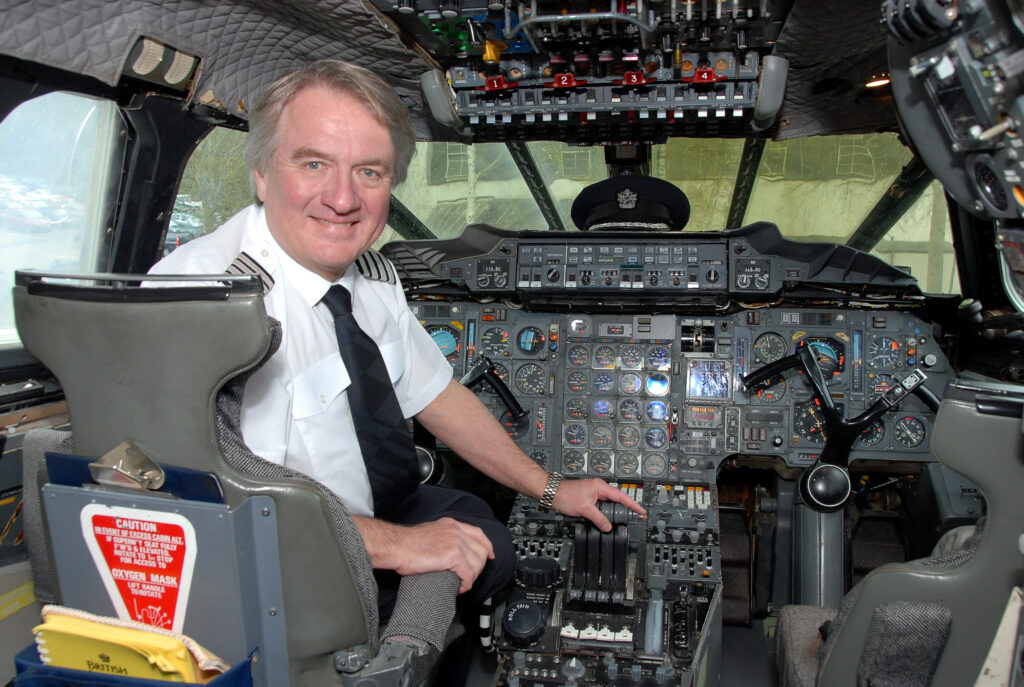 Captain Mike Bannister, Former Chief Concorde Pilot, British Airways
SUPERSONIC CHECK-IN
At the airports served by Concorde, passengers experienced the “Concorde Welcome” from the moment they arrived at the dedicated Concorde check-in area. Concorde customer service agents were specially trained to look after high-net-worth individuals, many of whom were accustomed to “flying private” on charter aircraft operating from corporate business-executive air terminals. During the passenger and baggage check-in procedures, it was important for airline employees to know the correct forms of salutation for addressing dukes and duchesses, members of royal families, ambassadors and diplomats, captains of industry, and other VIP individuals.
When passengers presented their distinctively branded Concorde tickets, they received glossy Concorde-identity bag tags for their suitcases and carry-on hand luggage. After the supersonic flight, these identity tags often stayed on passengers’ briefcases and travel bags as cherished status symbols and souvenirs.
In the dedicated Concorde Lounge, during butler-style service of sophisticated cocktails and elegant nibbles, small groups of supersonic “regulars” would gather to chat with each other before being escorted personally by the airline’s special service staff to the waiting aircraft.
SUPERSONIC ONBOARD EXPERIENCE
The aircraft boarding process was calm and unhurried, with Concorde flight attendants greeting passengers by name and offering to stow coats, hats, and bulky bags in special closet areas (the overhead stowage bins were only suitable for slim briefcases and document portfolios).
Concorde accommodated 40 passengers in the front cabin and 60 in the rear cabin, though newcomers were often surprised that the fuselage width was similar to that of a regional jet, with two seats on each side of the aisle. The cool white cabin lighting gave a silvery glow to the sleek gray leather seat covers. The seat width was 17 inches, with the seat backs and seat cushions upholstered in shape contours associated with the interiors of Lamborghini and Maserati super-sports cars. The seat-pitch measurement was just 37–38 inches, similar to configurations currently flying in the Premium Economy Class cabins of a number of international airlines. Although the aisle width was only 16 inches, Concorde’s central ceiling height was about 76 inches, a very generous stand-up measurement compared with the low ceiling height of many business jets.
Space inside the supersonic cabin was limited, and British Airways product training courses likened the Concorde passenger ambiance to travelling in an E-type Jaguar, as opposed to travelling in the larger passenger compartment of a traditional Rolls-Royce. Top-level VVIP passengers were normally allocated seats in the front cabin because it was quieter than the rear cabin, which was situated closer to Concorde’s Olympus engines.
Passengers regularly remarked that they never had feelings of jetlag after completing supersonic transoceanic crossings, and British Airways advertised the flight as “Like a Spring Morning” because Concorde was pressurized at the equivalent of about 5,500 feet above sea level. (In those days, many subsonic aircraft types were pressurized at the equivalent of about 7,000 or 8,000 feet, resulting in oxygen deprivation, which can be one of the main contributing causes of jetlag.)
At the front of each cabin, a Machmeter ticked up as Concorde flew faster than a rifle bullet and at an altitude twice the height of Mount Everest. This resulting view was the main visual attraction for Concorde passengers. Why? Well, there were no seat-back TV screens in those days.
The closeness of the seating accommodations encouraged conviviality. It was customary for passengers to speak with the people alongside them about the Concorde flying experience: the excitement of acceleration, going through Mach 1, the complete lack of turbulence at 58,000 feet, the progress of the flight, and the unforgettable view of the indigo-colored horizon visible through Concorde’s tiny window panes (measuring just 6.50 inches high and 4.50 inches wide).
For many Concorde passengers, the most exciting aspect of their journey was Celebrity-Spotting! Concorde was a favorite mode of transport for “A-list” society names, Wall Street “Masters of the Universe”, entertainment moguls, famous film stars, and chart-topping recording artists. Before the days of online computer communications that we now take for granted, the Great, the Good and the Unusual had to physically appear to sign contracts and give face-to-face presentations. So just imagine who you might find sitting next to you or just across the narrow aisle on a Concorde flight.
Mike Bannister recalled that it was not unusual, before 11 September 2001, for passengers, both first-timers and the “regulars,” to come up to the Flight Deck during supersonic cruise. “We loved to see and chat with them,” Bannister added. “Some even became long-term friends.”
NEXT-GENERATION SUPERSONIC TRANSPORT (SST)
Exciting news! During America’s 250th anniversary celebrations, Boom Supersonic Founder and CEO, Blake Scholl, announced the development program for Symphony, a medium-bypass turbofan engine purpose-built for Overture, the company’s future commercial second-generation supersonic aircraft, saying: “Overture will get you to global destinations two times faster.”
The company’s advertising presentation shows how the sound waves of Overture’s dreaded, ear-splitting sonic boom will be refracted upwards instead of hitting the ground.
Forecasting New York to London at Mach 1.7, flying at 60,000 feet, Boom Supersonic already has orders for Overture from American Airlines, Japan Airlines, and United Airlines, with deliveries projected for the 2030s.
The Human Race, according to Captain Bannister, has always wanted to go faster. From the domestication of the horse 6,500 years ago, through sailing and power boats, cycles and motorbikes, cars and trains, speed is a burning desire. Bannister is confident that supersonic passenger travel will return.
THE CONCORDE LEGACY
Concorde pioneered and established first-generation supersonic passenger services, and aviation manufacturing companies can now move ahead with strategies to develop the second-generation commercial supersonic platform. Given Concorde’s unique legacy, time-sensitive airline passengers will certainly want to beat a path to the entry door of Boom Supersonic’s Overture.
How supersonic time flies!
Jennifer’s JETLINER CABINS E-Book (4th edition) can be purchased on Amazon here: https://www.amazon.com/dp/B0D1ZKKGBW?lv=shuf&channelId=751&ref_=cm_sw_r_cp_ud_dp_P3ZEWD8WWVQ5DV506GRM&plpRedirect=mhFallback and on Apple iBooks here: https://books.apple.com/us/book/jetliner-cabins-evolution-innovation/id6504838807
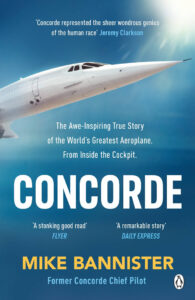
* Captain Mike Bannister, Former Chief Concorde Pilot, British Airways has also written a book entitled, Concorde: The thrilling account of history’s most extraordinary airliner. The book can found purchased on Amazon here: https://www.amazon.ca/Concorde-thrilling-account-worlds-fastest-ebook/dp/B09PQ8H7H3